

Employee Shuttle Service in Atlanta: Routes, Schedules and What a Company Shuttle Costs
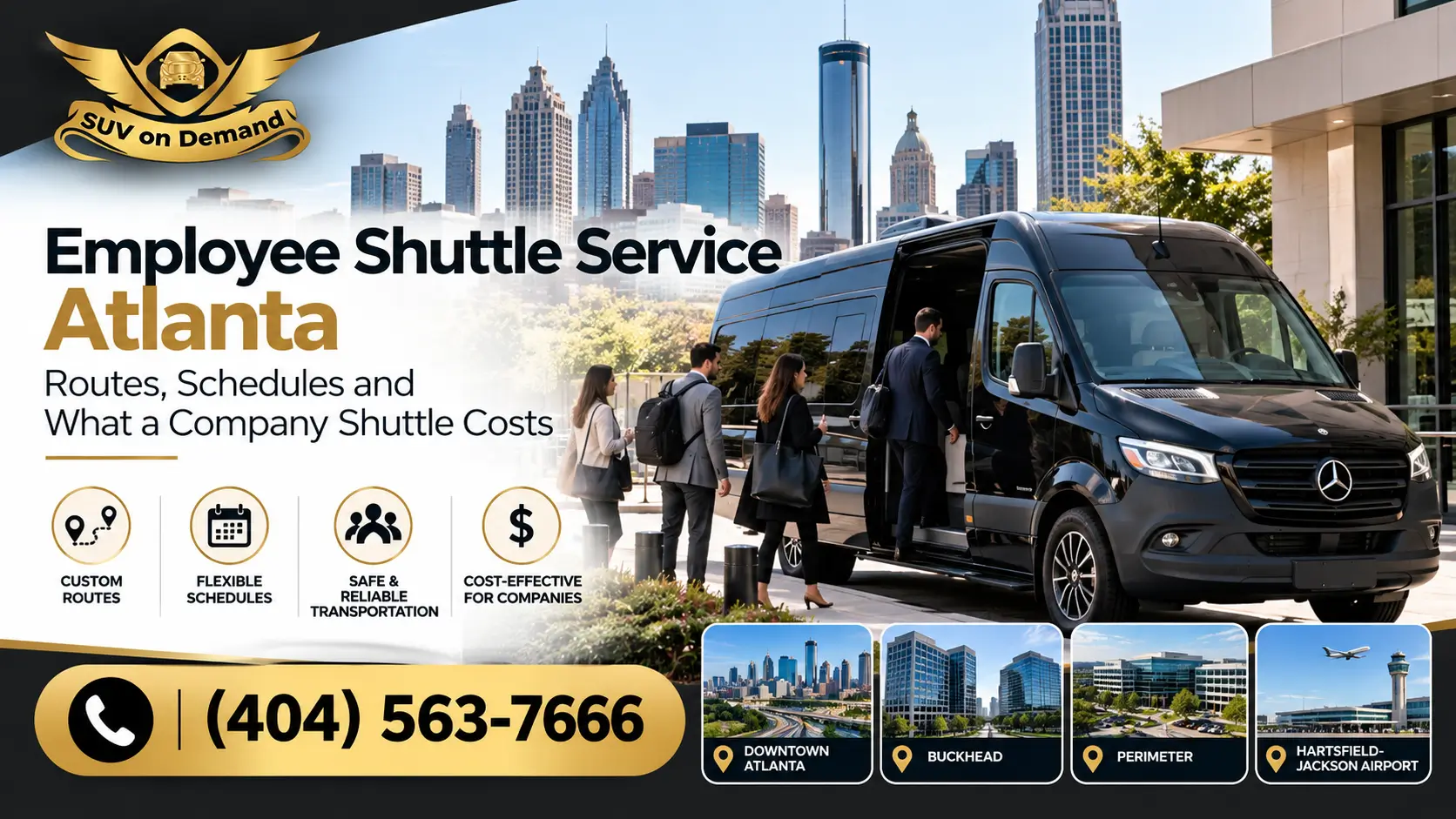
Quick answer: An employee shuttle service in Atlanta moves staff between a fixed set of stops, such as MARTA stations, park-and-ride lots or neighborhoods, and the workplace on a set schedule. Most company shuttles are priced by the vehicle-hour, so the final cost depends on vehicle size, route length, hours of service and whether you choose a dedicated contract or on-demand service. A well-designed route follows your shift times, uses a small number of high-demand stops and is measured by ridership from day one. SUV On Demand designs and runs company shuttles across metro Atlanta. See our company shuttle service or request a quote today.
Professional, licensed drivers · Well-maintained fleet · Custom routes and schedules · Clear, written quotes
Atlanta commutes are long, unpredictable and spread across a wide metro area. Employees come from Gwinnett, Cobb, South Fulton, DeKalb and beyond, and many offices sit far from a MARTA station or have limited parking. A company shuttle solves several problems at once: it shortens the last mile, cuts parking costs, helps with hiring and retention, and gives employees a reliable way to get to work. This guide covers when companies add a shuttle, how to design routes and schedules, vehicle sizes, contract versus on-demand service, cost factors, and how to measure ridership so the program keeps earning its budget.
This guide goes with our company shuttle service. If you are planning a program, read on and then share your requirements with our team.
Thinking about a company shuttle? Tell us your work locations, shift times and headcount and we will help you design a route and a quote.
When Companies Add an Employee Shuttle in Atlanta
Most shuttle programs begin with a specific, measurable problem. These are the situations where a shuttle most often makes sense.
| Situation | How a shuttle helps |
|---|---|
| Limited or expensive parking | Moves staff from remote lots or transit stops, which can reduce parking demand and cost |
| Last-mile gap from MARTA | Connects a MARTA station to an office park, campus or industrial site that is too far to walk |
| Multiple campuses or buildings | Moves employees between offices, labs, warehouses and training centers during the day |
| Shift work and off-hours schedules | Covers early, late and overnight shifts when transit service is limited |
| Hiring and retention challenges | Widens the pool of candidates who can reach the job without a car |
| Office relocation or return-to-office | Eases the transition when a new location is harder to reach |
| Airport-area and industrial employers | Connects workers to sites around Hartsfield-Jackson and nearby industrial areas |
Route and Schedule Design
The route and schedule decide whether a shuttle is used or ignored. The best programs are built from real employee data, not guesses.
Start with data
- Home ZIP codes. Map where employees live to find clusters of demand.
- Shift start and end times. Align arrivals and departures with the actual schedule.
- Commute pain points. Identify the worst corridors and the stations or lots people already use.
- A short employee survey. Ask who would ride, from where and at what times.
Choose the type of route
| Route type | How it works | Best for |
|---|---|---|
| Station loop | Runs between a MARTA station or transit hub and the workplace | Offices and campuses a short distance from transit |
| Park-and-ride | Connects a large parking lot, often near a highway, with the workplace | Employees driving in from outer suburbs |
| Neighborhood or multi-stop route | Picks up at a handful of stops in areas with many employees | Large employers with clustered home locations |
| Point-to-point | Runs between two sites, such as headquarters and a satellite campus | Multi-site companies |
| Shift-based service | Runs only at shift change times, often early or late | Manufacturing, logistics, healthcare and hospitality |
Atlanta route considerations
- Know the corridors. I-75, I-85, I-20, GA-400 and I-285 each have their own congestion patterns. Peak hours on the Connector and the Perimeter can change trip times significantly.
- Use known hubs. Stations and areas such as Midtown, Five Points, Lindbergh, Doraville, North Springs, the airport area, Perimeter Center, Buckhead and Cumberland are common anchor points, depending on where your workplace sits.
- Keep stops limited. Every stop adds time. Fewer, better-located stops make a faster and more reliable route.
- Test at real commute times. Run the route during actual rush hours before you finalize the schedule.
- Plan for weather and events. Storms, game days and major events can slow the metro area, so build in some buffer.
Schedule design
- Match shifts, not just clock times. Arrive 10 to 15 minutes before a shift starts and depart soon after it ends.
- Set a frequency that fits demand. A shuttle every 15 to 20 minutes during peaks works for high-volume routes, while lower-demand routes can run on a longer interval.
- Plan for the return trip. The evening ride matters just as much as the morning one.
- Add a late-ride option. Consider a limited guaranteed or on-request ride for employees who work late.
- Publish a simple schedule. Clear timetables, stop maps and a contact number increase ridership.
Vehicle Sizes for a Company Shuttle
The right vehicle depends on how many people ride per trip, how often the shuttle runs and how much space riders want. Smaller vehicles with more frequent trips often serve employees better than one large vehicle that runs rarely.
| Vehicle | Typical passenger range | Best for |
|---|---|---|
| Executive SUV | Up to about 6 passengers | Executive transfers, small teams and low-volume routes |
| Sprinter or passenger van | About 10 to 14 passengers | Small and mid-size shuttle routes with frequent trips |
| Minibus | About 20 to 35 passengers | Mid-volume routes and shift changes |
| Full-size motorcoach | About 45 to 56 passengers | High-volume commuter routes and large employer sites |
Tips for choosing a size
- Size for the peak, then check the off-peak. A vehicle that is right at shift change may be empty the rest of the day.
- Consider two smaller vehicles. More frequent service often beats one large bus.
- Plan for accessibility. Make sure the program can accommodate riders with mobility needs.
- Check site access. Confirm the vehicle can turn, load and park at each stop and at your workplace.
Contract Shuttle vs. On-Demand Service
Companies usually choose between a dedicated, scheduled contract and a flexible on-demand arrangement. Some use both.
| Factor | Contract shuttle | On-demand service |
|---|---|---|
| How it runs | Fixed routes and schedules with dedicated vehicles and drivers | Booked as needed for specific trips or time windows |
| Best for | Daily commuter service, shift changes and predictable demand | Pilots, events, variable demand and special trips |
| Cost structure | Typically a set hourly, daily or monthly rate, often with minimums | Pay per trip or per hour of use |
| Commitment | Longer-term agreement | Little or no long-term commitment |
| Consistency | Same drivers, vehicles and routes build familiarity | Flexible but less predictable |
| Risk | Pay for the service even when ridership dips | Higher per-trip cost if used heavily |
A smart way to start
Many companies begin with a short pilot, often 60 to 90 days, on one or two routes. They measure ridership, collect feedback and then decide whether to move to a longer contract, add routes or adjust the schedule.
What a Company Shuttle Costs
Shuttle pricing depends on the vehicle, the hours of service and the contract structure. The ranges below are approximate planning figures, not a quote. Rates vary by provider, season and demand, and many services apply minimum hours.
| Vehicle | Approx. rate per vehicle-hour | Notes |
|---|---|---|
| Executive SUV | $75 to $125 | Best for low-volume or executive service |
| Sprinter or passenger van | $90 to $150 | Common for small and mid-size routes |
| Minibus | $110 to $180 | Suited to mid-volume routes and shift changes |
| Full-size motorcoach | $150 to $250+ | High-capacity commuter service |
What drives the price up or down
- Vehicle size. Larger vehicles cost more per hour.
- Hours of service. Total daily and weekly hours are the biggest cost driver.
- Route length and traffic. Longer routes and congested corridors add time.
- Frequency. More trips need more vehicle time or more vehicles.
- Minimum hours and deadhead time. Time spent positioning vehicles may be billed.
- Contract length. Longer commitments can lower the rate, while short-term and on-demand service often costs more per hour.
- Early, late and weekend service. Off-peak hours can add a premium.
- Extras. Branding, onboard Wi-Fi, ride-tracking tools, accessibility needs and added insurance can change the price.
Think in cost per ride
The most useful way to judge a shuttle is cost per rider. Divide the total monthly shuttle cost by the number of rides taken. A route with high ridership can cost far less per ride than a cheaper route that few people use.
Want a firm quote for your shuttle program? Share your details and we will confirm the price before you commit.
Measuring Ridership and Success
A shuttle is easy to start and hard to improve if you do not measure it. Track a few simple numbers from the first week.
| Metric | What it tells you |
|---|---|
| Boardings per trip | How full each run is and whether the vehicle size is right |
| Total weekly and monthly riders | Overall adoption and growth over time |
| Cost per ride | Whether the program is efficient |
| On-time performance | Whether the schedule is realistic and reliable |
| Peak vs. off-peak use | Where to add or remove trips |
| Stop-level boardings | Which stops are worth keeping, moving or removing |
| Employee satisfaction | How riders feel about comfort, safety and convenience |
| Parking and attendance impact | Whether the shuttle is reaching the original business goal |
Simple ways to track ridership
- Driver counts at each stop, recorded by trip.
- A basic digital sign-in, QR code or ride-tracking app.
- A short pulse survey every month or quarter.
- Regular check-ins with your shuttle provider to review the numbers together.
Adjust based on what you learn
- Remove stops that few people use and add stops where demand is growing.
- Move departure times closer to real shift patterns.
- Swap vehicle sizes if trips are consistently too full or too empty.
- Promote the shuttle inside the company if ridership is lower than expected.
Before You Start: A Quick Checklist
- Define the goal of the program in a sentence.
- Map employee home locations and shift times.
- Choose one or two pilot routes and a 60 to 90 day trial period.
- Select a vehicle size that matches peak demand and allows frequent trips.
- Decide between a contract and on-demand structure.
- Confirm stop locations, loading areas and workplace access.
- Set the metrics you will track and who will review them.
- Communicate the schedule clearly to employees before launch.
About SUV On Demand
SUV On Demand provides transportation across metro Atlanta, including executive SUV service, group transportation and company shuttles. Our professional drivers and well-maintained vehicles are matched to your route, schedule and headcount. Learn more about our company shuttle service.
Employee Shuttle Service in Atlanta FAQs
How much does an employee shuttle service cost in Atlanta?
Most shuttles are priced by the vehicle-hour. Planning ranges run from roughly $75 to $250+ per hour depending on vehicle size, hours of service and contract structure. A written quote gives you the real number.
When does it make sense to add a company shuttle?
Common reasons include limited parking, a last-mile gap from MARTA, multiple campuses, shift work, hiring challenges and office relocations. Start with a clear goal.
How do I design a shuttle route?
Map where employees live, match the schedule to shift times, choose a small number of high-demand stops and test the route at real commute times. A short employee survey helps.
What size vehicle do I need?
It depends on riders per trip. Small routes use SUVs or vans, mid-volume routes use minibuses and high-volume routes use motorcoaches. More frequent trips in smaller vehicles often serve employees better.
What is the difference between a contract shuttle and on-demand service?
A contract shuttle runs fixed routes and schedules with dedicated vehicles. On-demand service is booked as needed with little commitment. Many companies pilot with on-demand service, then move to a contract.
How long should a shuttle pilot run?
Many companies run a 60 to 90 day pilot on one or two routes, which gives enough time to see real ridership patterns and collect employee feedback.
How do I measure whether the shuttle is working?
Track boardings per trip, total riders, cost per ride, on-time performance, stop-level use and employee satisfaction. Review the numbers regularly and adjust routes and schedules.
Can the shuttle connect to MARTA?
Yes. Many shuttle programs run between a MARTA station or transit hub and the workplace. Share your location and shift times and we will recommend a route.
Can you run early-morning, late-night or weekend shifts?
Yes, shift-based service can be arranged. Off-peak hours may carry a premium, so share your full schedule when you request a quote.
How do I get started?
Visit our company shuttle page to request a quote. We will review your locations, shift times and headcount and recommend a route and vehicle plan.
Plan Your Employee Shuttle in Atlanta
Talk to SUV On Demand about routes, schedules, vehicles and cost.


